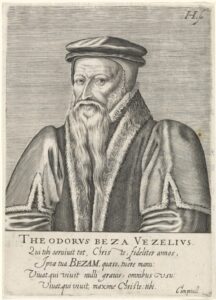
_Icones_virorum_nostra_patrumq._memoria_illustrium_(serietitel),_RP-P-1905-2450.jpg)
Theodore Beza
1519-1605 · Vézelay, Orléans, Paris, Lausanne, Geneva
In brief
Theodore Beza (Théodore de Bèze) was a French poet turned theologian who joined John Calvin in Geneva and succeeded him in 1564. He was the first rector of the Geneva Academy, and his Greek editions of the New Testament were basic sources for the Geneva Bible and the King James Version. He led the Geneva church for 41 years after Calvin died.1
Life at a glance
- 1519 Born June 24 in Vézelay, France.
- 1535-1539 Studies law at Orléans, then practices law in Paris.
- 1548 Publishes Juvenilia, a book of Latin love poems that makes his name as a poet. After a serious illness and a conversion, he goes to Geneva to join Calvin.
- 1549 Becomes professor of Greek at Lausanne. There he writes in defense of the burning of Michael Servetus, who was executed in Geneva in 1553.
- 1558 Returns to Geneva after years of travel defending the Protestant cause.
- 1559 Founds the Geneva Academy with Calvin and becomes its first rector.
- 1564 Succeeds Calvin as leader of the Geneva church, and stays its chief pastor for the rest of his life.
- 1572 Welcomes French Protestants who survived the St. Bartholomew’s Day Massacre.
- 1574 Publishes On the Rights of the Magistrate, defending the right to revolt against tyranny.
- 1580 Publishes the Icones, portraits and short lives of reformers, and a history of the Reformed churches of France.
- 1581 Gives the University of Cambridge the Codex Bezae, a manuscript of the Gospels and Acts from about the 5th century.
- 1605 Dies in Geneva on October 13.2
What he taught
Calvin’s teaching, with more stress on discipline
In most matters Beza repeated Calvin’s views. Britannica says he put greater stress on church discipline and on strict obedience to authority.3
The right to resist tyranny
His On the Rights of the Magistrate (1574) grew out of the St. Bartholomew’s Day Massacre of 1572 and defended the right to revolt against a tyrant. Britannica says it overturned the earlier Calvinist teaching of obedience to all civil authority and became a major political manifesto of Calvinism.4
The text of the New Testament
Beza published Greek editions and Latin translations of the New Testament. Both were basic sources for the Geneva Bible and the King James Version (1611).5
Training pastors
Calvin and Beza founded the Geneva Academy to train students in humanist learning for the ministry and for public leadership. Beza led it as its first rector, and Britannica says it became a training ground for promoting Calvinist teaching.6
Beza’s record has hard parts too. He defended the burning of Servetus, and he faced charges of intolerance in his own day.7
In his own words
I have no intention, however, to imitate those who, in their eagerness for declamation and panegyric, have not so much adorned the truth as brought it into suspicion. Trying not how elegantly, but how truly I could write, I have preferred the style of simple narrative.
Life of John Calvin, opening8
Having been a spectator of his conduct for sixteen years, I have given a faithful account both of his life and of his death, and I can now declare, that in him all men may see a most beautiful example of the Christian character, an example which it is as easy to slander as it is difficult to imitate.
Life of John Calvin, closing9
How he connects
- 1548 Beza → Calvin. Beza travels to Geneva to join Calvin.
- 1559 Calvin and Beza. They found the Geneva Academy together, with Beza as first rector.
- 1564 Calvin → Beza. Beza succeeds Calvin as chief pastor of Geneva.
- After 1564 Beza on Calvin. Beza writes a Life of John Calvin. Its 1844 translator called it the work of “an eye-witness and intimate friend.”
- 1580 Beza and the founders. Beza’s Icones gathers portraits and short lives of reformers. The woodcuts of Zwingli, Bucer, Bullinger, Calvin, and Knox on this site come from a 1906 facsimile of it and its 1581 French edition.10
Read his writings
- Life of John Calvin, translated by Henry Beveridge, in Calvin’s Tracts Relating to the Reformation, vol. 1 (Calvin Translation Society, 1844). Free at the Internet Archive.
- Icones (Geneva, 1580), the Latin original. Free at e-rara.
- Beza’s Icones: Contemporary Portraits of Reformers, a 1906 facsimile of the portraits with English notes by C. G. McCrie. Free at the Internet Archive.
Questions people ask
What did Beza have to do with the King James Bible?
His Greek editions and Latin translations of the New Testament were basic sources for the King James Version (1611) and, before it, the Geneva Bible.11
What is the Codex Bezae?
A manuscript from about the 5th century with the Gospels and Acts in Greek and Latin. It was in Beza’s library, and he gave it to the University of Cambridge in 1581.12
Was Beza really Calvin’s equal?
Britannica says that, as theologian and administrator, Beza is considered Calvin’s equal, as well as his successor, in establishing Calvinism in Europe.13
Sources
- “Theodore Beza,” Britannica Editors, Encyclopaedia Britannica, accessed Sept. 26, 2026, https://www.britannica.com/biography/Theodore-Beza. ↩︎
- Britannica, “Theodore Beza” and “Michael Servetus“; for the Icones, the 1580 edition at e-rara. Accessed Sept. 26, 2026. ↩︎
- Britannica, “Theodore Beza,” accessed Sept. 26, 2026. ↩︎
- Britannica, “Theodore Beza,” accessed Sept. 26, 2026. ↩︎
- Britannica, “Theodore Beza,” accessed Sept. 26, 2026. ↩︎
- Britannica, “Theodore Beza” and “John Calvin,” accessed Sept. 26, 2026. ↩︎
- Britannica, “Theodore Beza,” accessed Sept. 26, 2026. ↩︎
- Theodore Beza, Life of John Calvin, trans. Henry Beveridge, in John Calvin, Tracts Relating to the Reformation, vol. 1 (Edinburgh: Calvin Translation Society, 1844), p. xxi, Internet Archive. ↩︎
- Beza, Life of John Calvin, in Tracts, vol. 1, p. c. ↩︎
- Britannica, “Theodore Beza“; Henry Beveridge, translator’s preface, Tracts, vol. 1 (1844), p. xiv; C. G. McCrie, ed., Beza’s Icones (1906), Internet Archive. ↩︎
- Britannica, “Theodore Beza,” accessed Sept. 26, 2026. ↩︎
- Britannica, “Theodore Beza,” accessed Sept. 26, 2026. ↩︎
- Britannica, “Theodore Beza,” accessed Sept. 26, 2026. ↩︎