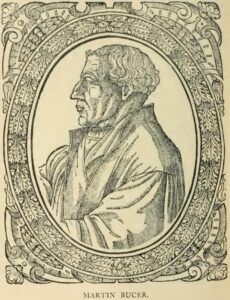

Martin Bucer
1491-1551 · Sélestat, Heidelberg, Strasbourg, Cambridge
In brief
Martin Bucer (also Butzer) led the Reformation in Strasbourg for about 25 years and spent much of that time trying to make peace between rival Protestant camps. John Calvin learned how to run a city church from him. Pushed out of Strasbourg in 1548, Bucer went to England at Archbishop Thomas Cranmer’s invitation and died there in 1551.1
Life at a glance
- 1491 Born November 11 in Schlettstadt (now Sélestat), Alsace.
- 1506 Joins the Dominican order, which later sends him to study at Heidelberg. There he reads Erasmus and Martin Luther.
- 1521 Leaves the Dominicans and enters the service of the count palatine of the Rhine.
- 1522 Becomes pastor at Landstuhl and marries a former nun.
- 1523 Excommunicated. He moves to Strasbourg, where his parents’ citizenship protects him, and rises to lead its church.
- 1529 At the Colloquy of Marburg, he and Zwingli offer Luther their hands. Luther refuses.
- 1536 Helps write the First Helvetic Confession in Basel. The same year at Wittenberg, he and Philipp Melanchthon broker an agreement with Luther on the Lord’s Supper, the Wittenberg Concord. It doesn’t last.
- 1538-1541 John Calvin, expelled from Geneva, pastors in Strasbourg and learns church administration from Bucer.
- 1541 Takes part in the Catholic-Protestant colloquy at Regensburg.
- 1548 Opposes the emperor’s Augsburg Interim. Strasbourg dismisses him, and Cranmer invites him to England.
- 1550 Lecturing at Cambridge, he writes that he can “set forth the kingdom of Christ with the most entire freedom.”
- 1551 Presents King Edward VI with a program for reforming England. A month before his death he delivers his critique of the English Prayer Book, the Censura. He dies on February 28.2
What he taught
Reform the people, then the rest
Bucer wanted to renew people and society through preaching the gospel and living by the Bible’s pattern: reform through conversion, piety, and discipline. He believed the essential goal was reforming the people, and that doctrinal disputes could be worked out later. His fullest statement of it was the program he gave Edward VI in 1551.3
Unity, even at a cost
Between 1524 and 1548, Bucer took part in nearly every meeting on religious questions held in Germany and Switzerland. When the parties couldn’t agree outright, he often proposed deliberately vague wording. Critics on every side accused him of having no convictions; he answered that each compromise was a temporary step. His pragmatism did the most harm when he helped persuade Luther, Melanchthon, and others to sanction a second marriage for Philip of Hesse, a leading Protestant prince. The scandal damaged the reformers’ reputations.4
The Lord’s Supper
Bucer stood between Zurich and Wittenberg, and the Swiss thought his 1536 concessions leaned too far toward Luther. In a letter from Cambridge in 1550, he insisted that “no one supposes a local presence of Christ in the supper,” while defending Christ’s real “exhibition and presence” there: a mystery that can be explained, he wrote, “to faith, but not to reason.”5
Tolerance for minorities
Under Bucer’s policies, Britannica notes, Strasbourg persecuted Anabaptists and other minority groups less than most of Europe did.6
Worship in England
Bucer’s Censura pointed out traces of Lutheran teaching in the First Prayer Book of Edward VI (1549). The Second Prayer Book (1552) drew on his criticism.7
In his own words
It is a very great alleviation of my anxiety, that I am permitted to set forth the kingdom of Christ with the most entire freedom, in my lectures, disputations, and Latin sermons.
Letter to Johannes Brenz, Cambridge, May 15, 15508
Affairs in this country are in a very feeble state: the people are in want of teachers.
Letter to Johannes Brenz, Cambridge, May 15, 15509
Considering by how many ties the Lord has bound me to you, and you to me, whom he has permitted for twenty-six years to serve your church and school, certainly with all fidelity, and not without labour, whatever the success may have been.
Letter to the ministers of Strasbourg, Cambridge, December 155010
How he connects
- 1529 Bucer and Zwingli. At Marburg, both offer Luther their hands.
- 1536 Bucer and Bullinger. Both help write the First Helvetic Confession.
- 1536 Bucer and Luther. Luther welcomes the Wittenberg agreement: “We are one, and we acknowledge and receive you as our dear brethren in the Lord.” Bucer reportedly wept.
- 1538-1541 Bucer → Calvin. In Strasbourg, Calvin learns church administration from Bucer.
- 1550 Bucer and Knox. In England, Bucer backs Cranmer’s cautious reform against the more radical program urged by John Hooper and John Knox.11
Read his writings
- Original Letters Relative to the English Reformation, second portion, edited by Hastings Robinson (Parker Society, 1847). Bucer’s letters from Cambridge, in English. Free at the Internet Archive.
- Free English translations of Bucer’s major works are hard to find. His letters are the best free place to hear him.
Questions people ask
Why does Bucer matter to the Reformed tradition?
Britannica says he influenced the development of Calvinism and the liturgy of the Anglican Communion. Calvin learned church administration from him in Strasbourg between 1538 and 1541.12
What was the Wittenberg Concord?
A 1536 agreement on the Lord’s Supper, reached at a Wittenberg conference between Lutheran theologians and those of southern Germany and Switzerland. Bucer and Melanchthon helped bring it about, and Melanchthon wrote it up. It didn’t produce a lasting union, and the Swiss disliked Bucer’s concessions to Luther.13
Why did Bucer leave Strasbourg?
In 1548 the emperor Charles V imposed his compromise, the Augsburg Interim. Bucer opposed Strasbourg’s accepting it. When the emperor’s armies prevailed, Strasbourg dismissed him, and Cranmer invited him to England.14
Sources
- “Martin Bucer,” by L. J. Trinterud and the Britannica Editors, Encyclopaedia Britannica, accessed Sept. 26, 2026, https://www.britannica.com/biography/Martin-Bucer; Britannica, “John Calvin.” ↩︎
- Britannica, “Martin Bucer” and “John Calvin“; for Cambridge, Bucer’s letter of May 15, 1550, in Original Letters Relative to the English Reformation, second portion, ed. Hastings Robinson (Cambridge: Parker Society, 1847), p. 543. ↩︎
- Britannica, “Martin Bucer,” accessed Sept. 26, 2026. ↩︎
- Britannica, “Martin Bucer,” accessed Sept. 26, 2026. ↩︎
- Britannica, “Martin Bucer“; Bucer to Johannes Brenz, May 15, 1550, in Original Letters, second portion, pp. 544-545, Internet Archive. ↩︎
- Britannica, “Martin Bucer,” accessed Sept. 26, 2026. ↩︎
- Britannica, “Martin Bucer,” accessed Sept. 26, 2026. ↩︎
- Bucer to Johannes Brenz (“Brentius”), Cambridge, May 15, 1550, letter 252 in Original Letters, second portion, p. 543. ↩︎
- Same letter, p. 543. ↩︎
- Bucer to the ministers of Strasbourg, Cambridge, December 1550, letter 254 in Original Letters, second portion, p. 549. ↩︎
- Britannica, “Martin Bucer,” “Heinrich Bullinger,” and “John Calvin,” accessed Sept. 26, 2026. ↩︎
- Britannica, “Martin Bucer” and “John Calvin.” ↩︎
- Britannica, “Martin Bucer,” accessed Sept. 26, 2026. ↩︎
- Britannica, “Martin Bucer,” accessed Sept. 26, 2026. ↩︎