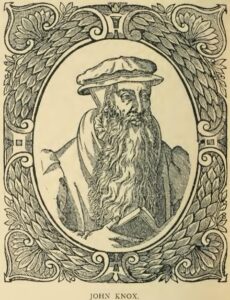

John Knox
c. 1514-1572 · Haddington, St Andrews, England, Geneva, Edinburgh
In brief
John Knox was the foremost leader of the Scottish Reformation. A priest turned Protestant preacher, he spent 19 months as a galley slave, preached in England, and pastored English refugees in Geneva before returning to Scotland in 1559. The next year Scotland’s Parliament adopted the Scots Confession, which he helped prepare.1
Life at a glance
- c. 1514 Born near Haddington, East Lothian. Almost nothing is known of his life before 1540.
- 1540 In priest’s orders by this year. By 1543 he also works as a notary near Haddington.
- 1545-1546 Travels with the preacher George Wishart, the source of his full conversion. Wishart is burned for heresy in March 1546.
- 1547 At St Andrews castle, the Protestants call him to preach. He resists with tears, then accepts. That summer the castle falls, and he is carried off to the French galleys.
- 1549 Freed after 19 months through English intervention, his health permanently broken. He becomes a licensed preacher in England, first at Berwick-upon-Tweed.
- 1551-1553 Moves to Newcastle, and soon after becomes one of 6 royal chaplains. He helps shape the Church of England’s articles and gets the “black rubric” into the Book of Common Prayer.
- 1553 The Catholic Mary Tudor takes the English throne. Knox is one of the last Protestant leaders to flee.
- 1554 At Calvin’s urging, he pastors English refugees in Frankfurt for a few months, then leads the English congregation in Geneva.
- 1555-1556 Spends 9 months in Scotland and marries Marjorie Bowes. He leaves behind a Letter of Wholesome Counsel urging family worship and weekly Bible study meetings.
- 1558 Publishes The First Blast of the Trumpet against the Monstruous Regiment of Women (“regiment” meaning rule). Elizabeth I, newly crowned, bars him from England for good.
- 1559 Back in Scotland by early May. By the end of June he is preaching at St Giles’ in Edinburgh.
- 1560 Scotland’s Parliament adopts the Scots Confession, prepared by Knox and 3 others, and abolishes papal jurisdiction. Marjorie Bowes dies.
- 1572 Dies in Edinburgh on November 24.2
What he taught
The right to resist
Watching Mary Tudor undo England’s reform, Knox concluded that God-fearing magistrates and nobles have both the right and the duty to resist, by force if necessary, a ruler who threatens true religion. He later applied that conclusion in Scotland.3
A church governed by elected elders
The First Book of Discipline, which Knox and other churchmen presented to Scotland’s Parliament, called for congregations governed by elected elders. Its stress on lay participation laid the groundwork for Presbyterianism. Its plans for schools and poor relief were never fully carried out, for lack of money.4
Worship at home and in small meetings
In his Letter of Wholesome Counsel (1556), Knox urged private family worship and weekly meetings of believers to study the Bible together. Reformed congregations grew from those meetings, and their leaders became the elders of the Reformed Church.5
Against rule by women
The First Blast of the Trumpet argues, with what Britannica calls “uncurbed vehemence,” the common belief of his day that authority exercised by women is contrary to natural law and to revealed religion. It was aimed at the 3 women then governing England, France, and Scotland, who were suppressing Protestantism. It appeared just as the Protestant Elizabeth I took the English throne, and she barred Knox from England for good.6
In his own words
Knox wrote his History about himself in the third person. Both passages are his own account.
Thereat the said John, abashed, burst forth in most abundant tears, and withdrew himself to his chamber.
History of the Reformation in Scotland, book 1, on his call to preach7
Madam, I speak in God’s presence. I never delighted in the weeping of any of God’s creatures; yea, I can scarcely well abide the tears of my own boys whom my own hand corrects, much less can I rejoice in your Majesty’s weeping.
History of the Reformation in Scotland, book 4, to Mary, Queen of Scots8
Seeing, however, that I have offered you no just occasion to be offended, but have spoken the truth as my vocation craves of me, I must sustain your Majesty’s tears, albeit unwillingly, rather than dare hurt my conscience, or betray my commonwealth through my silence.
History of the Reformation in Scotland, book 4, continuing9
How he connects
- 1550 Bucer and Knox. In England, Bucer backs Cranmer’s cautious reform against the more radical program urged by John Hooper and Knox.
- 1554 Calvin → Knox. At Calvin’s urging, Knox pastors English refugees in Frankfurt, then leads the English congregation in Geneva until 1559.
- 1556-1558 Knox in Geneva. Britannica calls Geneva the city where Knox spent “the happiest years of his life.”
- 1560 Geneva → Scotland. The Scots Confession sets out a Calvinist faith for Scotland.
- 1580 Beza → Knox. Beza includes Knox’s portrait in his Icones. A 1905 edition of Knox’s History calls it “the only authentic Portrait.”10
Read his writings
- The History of the Reformation of Religion in Scotland, revised and edited by Cuthbert Lennox (1905), with modernized spelling. Includes Knox’s Confession and the Book of Discipline. Free at Project Gutenberg.
- The Scots Confession (1560) in its original Scots, in Philip Schaff, The Creeds of Christendom, vol. 3. Free at CCEL.
Questions people ask
Why is Knox called the father of Presbyterianism?
Because his First Book of Discipline called for congregations governed by elected elders, with a large role for lay people. Britannica says this “laid the groundwork for Presbyterianism.”11
Did John Knox know John Calvin?
Yes. Knox went to Frankfurt at Calvin’s insistence in 1554, then pastored the English congregation in Geneva, on and off, until 1559.12
What was The First Blast of the Trumpet?
Knox’s 1558 pamphlet arguing that rule by women is against nature and Scripture. It targeted the women then governing England, France, and Scotland, but it came out just as Elizabeth I took the throne, and she barred him from England for good. See “Against rule by women” above.
Sources
- “John Knox,” by James Stevenson McEwen and the Britannica Editors, Encyclopaedia Britannica, accessed Sept. 26, 2026, https://www.britannica.com/biography/John-Knox. ↩︎
- Britannica, “John Knox,” accessed Sept. 26, 2026. ↩︎
- Britannica, “John Knox,” section on his flight from England. ↩︎
- Britannica, “John Knox,” summary of the First Book of Discipline. ↩︎
- Britannica, “John Knox,” section on his 1555-1556 visit to Scotland. ↩︎
- Britannica, “John Knox,” section on his Geneva years. ↩︎
- John Knox, The History of the Reformation of Religion in Scotland, book 1, rev. and ed. Cuthbert Lennox (London: Andrew Melrose, 1905), Project Gutenberg. Lennox modernized the spelling. ↩︎
- Knox, History, book 4, ed. Lennox (1905). ↩︎
- Knox, History, book 4, ed. Lennox (1905). ↩︎
- Britannica, “John Knox” and “Martin Bucer“; Knox, History, ed. Lennox (1905), frontispiece caption. ↩︎
- Britannica, “John Knox,” accessed Sept. 26, 2026. ↩︎
- Britannica, “John Knox,” accessed Sept. 26, 2026. ↩︎