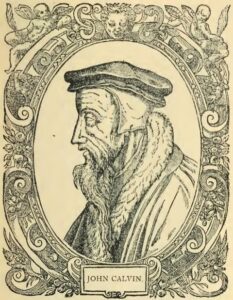

John Calvin
1509-1564 · Noyon, Paris, Basel, Strasbourg, Geneva
In brief
John Calvin was a French theologian who shaped the Reformation in Geneva, where he worked from 1536 to 1538 and again from 1541 until his death in 1564. His Institutes of the Christian Religion, first published in 1536 and expanded in later editions, became what Britannica calls “the single most important statement of Protestant belief.” The patterns he worked out for Geneva influenced Protestant churches across Europe and North America.1
Life at a glance
- 1509 Born July 10 in Noyon, Picardy, France.
- 1523 Sent to the University of Paris to prepare for the priesthood.
- 1528-1531 Studies law at Orléans and Bourges.
- 1533 Leaves Paris late in the year as the government grows less tolerant of reformers, and eventually reaches Basel.
- 1536 Publishes the first edition of the Institutes. Late in the year, Guillaume Farel finds him spending a night in Geneva and persuades him to stay.
- 1538 Expelled from Geneva with Farel in May. Spends 3 years in Strasbourg, pastoring French-speaking refugees and learning how to run a city church from Martin Bucer.
- 1540 Marries Idelette de Bure in Strasbourg. None of their children survive infancy.
- 1541 Invited back to Geneva in September. In November the town council enacts his Ecclesiastical Ordinances.
- 1549 Reaches agreement with Heinrich Bullinger of Zurich in the Consensus Tigurinus.
- 1553 Michael Servetus is burned for heresy at Champel on October 27, after a trial in which Calvin played a prominent role. The execution drew criticism toward Calvin.
- 1555 In May, prevails in his long struggle over control of Geneva.
- 1559 Founds the Geneva Academy with Theodore Beza, its first rector.
- 1564 Dies in Geneva on May 27, at 54. Beza succeeds him.2
What he taught
Knowing God and knowing ourselves
Calvin opens the Institutes with this claim: true wisdom has 2 parts, the knowledge of God and the knowledge of ourselves, and the two are tied together. No one can look honestly at himself without being turned toward “the God in whom he lives and moves.”3
Scripture as glasses
Creation gives everyone some impression of God, Calvin taught, but a confused one. Scripture works like glasses for weak eyes. It gathers those impressions, “dissipates the darkness, and shows us the true God clearly.”4
Justification by faith
Calvin called justification “the principal ground on which religion must be supported.” We receive free justification by faith alone, through God’s mercy, and that faith is “not destitute of good works.”5
Predestination
Calvin is closely linked with predestination, which he defined this way: “By predestination we mean the eternal decree of God, by which he determined with himself whatever he wished to happen with regard to every man.” Some, he wrote, are “preordained to eternal life, others to eternal damnation.”6
Christians have argued over this teaching, including inside the Reformed churches. In the early 1600s it divided the Reformed Church of the Netherlands. See the question on the five points below.
Order for the church
Calvin’s Ecclesiastical Ordinances (1541) set up 4 kinds of church officers in Geneva: pastors and teachers to preach and explain Scripture, elders to help govern the church, and deacons to handle its charitable work. A consistory of pastors and elders oversaw moral discipline across the city, and a significant part of the population resented it.7
In his own words
Our wisdom, in so far as it ought to be deemed true and solid Wisdom, consists almost entirely of two parts: the knowledge of God and of ourselves.
Institutes 1.1.18
For as the aged, or those whose sight is defective, … when aided by glasses, begin to read distinctly, so Scripture, gathering together the impressions of Deity, which, till then, lay confused in our minds, dissipates the darkness, and shows us the true God clearly.
Institutes 1.6.19
For unless you understand first of all what your position is before God, and what the judgment which he passes upon you, you have no foundation on which your salvation can be laid, or on which piety towards God can be reared.
Institutes 3.11.110
How he connects
- 1531 Zwingli and Calvin. Calvin was 22 when Huldrych Zwingli died.
- 1536 Farel → Calvin. Farel persuades Calvin to stay in Geneva.
- 1538-1541 Bucer → Calvin. In Strasbourg, Calvin learns church administration from Martin Bucer.
- 1548 Calvin → Beza. Theodore Beza travels to Geneva to join Calvin.
- 1549 Calvin ↔ Bullinger. The two reach agreement in the Consensus Tigurinus.
- 1550s Calvin → Knox. At Calvin’s urging, John Knox pastors English refugees in Frankfurt, then leads the English congregation in Geneva until 1559.
- 1564 Calvin → Beza. Beza succeeds Calvin as chief pastor of Geneva.11
Read his writings
- Institutes of the Christian Religion, translated by Henry Beveridge (1845). Free at CCEL. Start with Book 1, chapter 1.
- Tracts Relating to the Reformation, vol. 1 (Calvin Translation Society, 1844). Opens with Theodore Beza’s Life of John Calvin. Free at the Internet Archive.
- Calvin’s commentaries on most of the Bible. Free at CCEL.
Questions people ask
What did John Calvin believe about salvation?
That we’re justified freely, by God’s mercy, through faith alone, and that this faith always bears good works. He also taught that God’s eternal decree determines who is saved. See “Justification by faith” and “Predestination” above.
Did Calvin believe in infant baptism?
Yes. Book 4, chapter 16 of the Institutes defends it under the title “Pædobaptism. Its accordance with the institution of Christ, and the nature of the sign.”12
Did Calvin write the five points of Calvinism?
No. The five points come from the Canons of the Synod of Dort, which met from November 1618 to May 1619, more than 50 years after Calvin died. The synod answered the 5 articles of the Remonstrants, Dutch followers of Jacobus Arminius who rejected the strict Calvinist doctrine of predestination.13
Where is John Calvin buried?
He asked to be buried in an unmarked grave. He’s believed to lie somewhere in the Cimetière des Rois in Geneva.14
Sources
- “John Calvin,” by William J. Bouwsma and the Britannica Editors, Encyclopaedia Britannica, updated Aug. 12, 2026, https://www.britannica.com/biography/John-Calvin. ↩︎
- Dates from Britannica’s articles “John Calvin,” “Theodore Beza,” and “Michael Servetus,” accessed Sept. 26, 2026. ↩︎
- John Calvin, Institutes of the Christian Religion, trans. Henry Beveridge (1845), book 1, chapter 1, section 1, CCEL. ↩︎
- Institutes 1.6.1, trans. Beveridge, CCEL. ↩︎
- Institutes 3.11.1, trans. Beveridge, CCEL. ↩︎
- Institutes 3.21.5, trans. Beveridge, CCEL. ↩︎
- Britannica, “John Calvin,” section on Calvin’s return to Geneva in 1541. ↩︎
- Institutes 1.1.1, trans. Beveridge, CCEL. ↩︎
- Institutes 1.6.1, trans. Beveridge, CCEL. The ellipsis marks words left out of the middle of the sentence. ↩︎
- Institutes 3.11.1, trans. Beveridge, CCEL. ↩︎
- Britannica, “John Calvin,” “Heinrich Bullinger,” “Theodore Beza,” and “John Knox,” accessed Sept. 26, 2026. ↩︎
- Institutes 4.16, chapter title, trans. Beveridge, CCEL. ↩︎
- Britannica, “Synod of Dort,” accessed Sept. 26, 2026. ↩︎
- Britannica, “John Calvin,” accessed Sept. 26, 2026. ↩︎