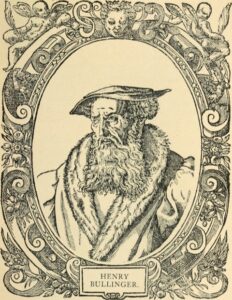
_and_in_Goulard%27s_edition_(1581)_(1906)_(14580117797).jpg)
Heinrich Bullinger
1504-1575 · Bremgarten, Cologne, Kappel, Zurich
In brief
Heinrich Bullinger succeeded Huldrych Zwingli as Zurich’s chief pastor in 1531, at 27, and led its church for 44 years. He reached agreement with John Calvin in 1549 and wrote the Second Helvetic Confession (1566), which became the confession of many Reformed churches. His surviving correspondence runs to about 12,000 letters.1
Life at a glance
- 1504 Born July 18 in Bremgarten, now in the canton of Aargau.
- 1519-1522 Studies at the University of Cologne and earns a master of arts. Reading the Church Fathers and the reformers there, he turns away from the Roman church.
- 1523-1529 Teaches at the monastery school in Kappel and becomes a committed follower of Zwingli.
- 1528 Takes part in the Bern disputation alongside Zwingli.
- 1529 Marries Anna Adlischwyler, a former nun of Zurich’s Oetenbach convent. Becomes pastor in Bremgarten, succeeding his father.
- 1531 Flees to Zurich during the Second War of Kappel. On December 9, after Zwingli’s death, he is called to succeed him.
- 1532 Writes an order for Zurich’s preachers and synod that becomes the church’s lasting constitution.
- 1536 Helps draft the First Helvetic Confession in Basel.
- 1549 Reaches agreement with Calvin on the Lord’s Supper in the Consensus Tigurinus.
- 1564-1574 Writes histories of the Reformation (1564), the Swiss Confederation (1568), and Zurich (1573-1574).
- 1566 His confession, printed at the request of Elector Frederick III of the Palatinate, becomes the Second Helvetic Confession.
- 1575 Dies in Zurich on September 17.2
What he taught
Scripture, and Scripture preached
Bullinger’s confession opens with Scripture. The canonical Scriptures are “the true Word of God,” with “sufficient authority of themselves, not of men.” When that Word is preached by lawfully called preachers, “the very Word of God is preached,” and it stays true even when the preacher is a sinner.3
The covenant
The Historical Dictionary of Switzerland calls Bullinger the foremost shaper of covenant theology. It adds that this theology still echoes in secular thinking about the state and its law.4
A church that stands on its own feet
After the defeat at Kappel, Bullinger rebuilt Zurich’s shaken church. His 1532 church order settled how the church and the city council relate. He expanded schools and scholarships to train new pastors, argued for the church’s interests before the council, and treated the freedom of the pulpit as a central concern.5
One Reformed family
Bullinger helped draft the First Helvetic Confession (1536), agreed with Calvin in 1549, and wrote the Second Helvetic Confession (1566). Britannica dates the beginning of the Reformed tradition, “the fusion of Zwinglian and Calvinist thought,” to these last two.6
Pastor and writer
His 124 works went through many editions in his lifetime. They include Bible commentaries, collections of sermons, and practical books on married life and on caring for the sick. His Decades are 50 sermons that cover, in his words, “the whole matter of faith, godliness or true religion, and also the church.”7
In his own words
Wherefore when this Word of God is now preached in the church by preachers lawfully called, we believe that the very Word of God is preached, and received of the faithful; and that neither any other Word of God is to be feigned, nor to be expected from heaven: and that now the Word itself which is preached is to be regarded, not the minister that preaches; who, although he be evil and a sinner, nevertheless the Word of God abides true and good.
Second Helvetic Confession (1566), chapter 18
For so great is the goodness of our good God and most loving Father, that not he himself is desirous to live happily and blessedly alone, but moreover to bestow and pour upon us men, his beloved creatures, all kind of blessedness; and that we should enjoy his goods by all means possible.
Decades, fifth decade, sermon 19
That which I do often repeat in all my sermons and my books, that do I also again repeat in this place; that the learned may with my good-will and thanks gather and embrace better things out of the scriptures.
Decades, the closing words10
How he connects
- 1523 Zwingli → Bullinger. Bullinger comes to know Zwingli and gradually adopts his theology.
- 1528 Zwingli and Bullinger. They take part in the Bern disputation together.
- 1531 Zwingli → Bullinger. Bullinger succeeds Zwingli as Zurich’s main pastor.
- 1536 Bullinger and Bucer. Both help write the First Helvetic Confession.
- 1549 Bullinger ↔ Calvin. The Consensus Tigurinus brings Zurich and Geneva into agreement on the Lord’s Supper.
- Letters Bullinger → England. His influence reaches England through letters to its rulers, including Henry VIII and Edward VI, and his correspondence had strong ties to England and Poland.11
Read his writings
- The Decades of Henry Bullinger, translated by “H. I.” and edited by Thomas Harding (Parker Society, 1849-1852). Free at the Internet Archive, for example the fifth decade.
- The Second Helvetic Confession in English, in Philip Schaff, The Creeds of Christendom, vol. 3. Free at CCEL.
Questions people ask
What is the Second Helvetic Confession?
Bullinger’s own statement of faith. It was printed in 1566 at the request of Elector Frederick III of the Palatinate and became the confession of many Reformed churches. The Historical Dictionary of Switzerland notes it is still in force in several churches in Eastern Europe.12
Did Bullinger and Calvin agree?
On the Lord’s Supper, yes. In 1549 they reached the Consensus Tigurinus, which brought the churches of Zurich and Geneva into agreement.13
What did Bullinger do after Zwingli died?
He took over a church shaken by the defeat at Kappel and made it strong again. He gave it a lasting church order in 1532, built up schools and scholarships for new pastors, brought respected scholars to Zurich’s school, and kept up a correspondence that reached across Europe.14
Sources
- “Heinrich Bullinger,” Britannica Editors, Encyclopaedia Britannica, updated Sept. 13, 2026, https://www.britannica.com/biography/Heinrich-Bullinger; Hans Ulrich Bächtold, “Bullinger, Heinrich,” Historisches Lexikon der Schweiz (1998, edited 2011), https://hls-dhs-dss.ch/de/articles/010443/2011-04-07/. ↩︎
- Bächtold, “Bullinger, Heinrich“; Britannica, “Heinrich Bullinger.” Both accessed Sept. 26, 2026. ↩︎
- Second Helvetic Confession, chapter 1, English version in Philip Schaff, The Creeds of Christendom, vol. 3, appendix, CCEL. ↩︎
- Bächtold, “Bullinger, Heinrich,” Historisches Lexikon der Schweiz. ↩︎
- Bächtold, “Bullinger, Heinrich,” Historisches Lexikon der Schweiz. ↩︎
- Bächtold, “Bullinger, Heinrich“; Britannica, “Heinrich Bullinger.” ↩︎
- Bächtold, “Bullinger, Heinrich“; Bullinger, The Decades, fifth decade, sermon 10, trans. H. I., ed. Thomas Harding (Cambridge: Parker Society, 1852), p. 526. ↩︎
- Second Helvetic Confession, chapter 1, in Schaff, Creeds of Christendom, vol. 3, appendix. ↩︎
- Bullinger, The Decades, fifth decade, sermon 1 (Parker Society, 1852), p. 3, Internet Archive. ↩︎
- Bullinger, The Decades, fifth decade, sermon 10 (Parker Society, 1852), p. 526. ↩︎
- Britannica, “Heinrich Bullinger“; Bächtold, “Bullinger, Heinrich.” ↩︎
- Bächtold, “Bullinger, Heinrich,” Historisches Lexikon der Schweiz. ↩︎
- Bächtold, “Bullinger, Heinrich“; Britannica, “Heinrich Bullinger.” ↩︎
- Bächtold, “Bullinger, Heinrich,” Historisches Lexikon der Schweiz. ↩︎