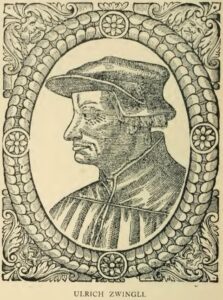

Huldrych Zwingli
1484-1531 · Wildhaus, Glarus, Einsiedeln, Zurich
In brief
Huldrych Zwingli (also spelled Ulrich or Huldreich) led the Reformation in Zurich and founded the Swiss Reformed Church. From Zurich’s Grossmünster he preached through the New Testament, published his 67 Articles in 1523, and broke with Martin Luther over the Lord’s Supper. He was killed in battle at Kappel in 1531, at 47.1
Life at a glance
- 1484 Born January 1 in Wildhaus, in the Toggenburg valley, now in the canton of St. Gallen.
- 1498-1504 Studies at Vienna and Basel, graduating from Basel in 1504.
- 1506 Becomes a priest in Glarus. He studies Greek, some Hebrew, and the Church Fathers, and writes to Erasmus.
- 1516 Moves to Einsiedeln. He later dated his new understanding of Scripture to this move.
- 1518 Appointed people’s priest at the Grossmünster in Zurich, where he begins preaching through the New Testament.
- 1519 Stays at his post through a serious plague and falls ill himself. His recovery, and his brother’s death the next year, deepen the spiritual side of his thinking.
- 1522 His preaching helps set off open breaches of the Lenten fast and of clerical celibacy, which begin the Swiss Reformation. He publishes The Clarity and Certainty of the Word of God.
- 1523 Publishes the 67 Articles for a January disputation in Zurich. Most priests in the district adopt his main points.
- 1524 Marries Anna Reinhard publicly on April 2. In 1524 and 1525 Zurich removes images from its churches and replaces the Mass with a simple Communion service.
- 1525 Publishes his Commentary on True and False Religion. He debates the Anabaptists, and Zurich’s council imprisons their leaders and later sentences them to death.
- 1528 With Heinrich Bullinger, takes part in the disputation that brings the Reformation to Bern.
- 1529 Meets Luther and Martin Bucer at the Colloquy of Marburg. They agree on most points but not the Lord’s Supper, and Luther refuses the hand Zwingli offers. The Zurich Bible appears.
- 1531 Killed on October 11 in the Second War of Kappel, where he went with Zurich’s forces as chaplain.2
What he taught
Scripture over the church’s approval
Zwingli’s first article is blunt: “All who say that the Gospel is invalid without the confirmation of the Church err and slander God.” He offered to defend all 67 articles from Scripture and to be corrected, “but only from said Scriptures.”3
Christ alone
“Hence Christ is the only way to salvation for all who ever were, are and shall be,” reads his third article. Anyone who points to “another door,” the fourth says, “errs.”4
The Lord’s Supper as a sign
Zwingli and Luther both rejected the Mass as a sacrifice, and both rejected the medieval teaching that the bread and wine change their substance. They split over the words “This is my body.” Luther held that Christ’s body and blood are truly present. Zwingli read “is” as “signifies,” and taught that Christ is present to the believer by the power of the Holy Spirit, as the bread and wine signify.5
Baptism as a covenant sign
Answering the Anabaptists, who rejected infant baptism, Zwingli wrote On Baptism (1525). Its main emphasis is water baptism as a sign of the covenant.6
God’s sovereignty
Zwingli stressed the sovereignty of God. Britannica notes that he balanced it with a milder view of original sin and a wide hope of salvation.7
In his own words
The articles and opinions below, I, Ulrich Zwingli, confess to have preached in the worthy city of Zurich as based upon the Scriptures which are called inspired by God, and I offer to protect and conquer with the said articles, and where I have not now correctly understood said Scriptures I shall allow myself to be taught better, but only from said Scriptures.
Sixty-seven Articles (1523), preamble8
The sum and substance of the Gospel is that our Lord Jesus Christ, the true Son of God, has made known to us the will of his heavenly Father, and has with his innocence released us from death and reconciled God.
Sixty-seven Articles (1523), article 29
How he connects
- 1528 Zwingli and Bullinger. Bullinger assists Zwingli at the Bern disputation.
- 1529 Zwingli and Luther. At Marburg, Luther refuses the hand Zwingli and Bucer offer.
- 1531 Zwingli → Bullinger. After Zwingli’s death, Bullinger becomes Zurich’s main pastor.
- 1531 Zwingli and Calvin. Calvin was 22 when Zwingli died. Britannica traces the fuller teaching of Bullinger, Peter Martyr Vermigli, and Calvin on the sacraments back to Zwingli’s rejection of them as means of obtaining grace.
- 1549 Zurich ↔ Geneva. Zwingli’s successor, Bullinger, reaches agreement with Calvin in the Consensus Tigurinus.10
Read his writings
- Selected Works of Huldreich Zwingli, edited by Samuel Macauley Jackson (1901). Letters, the 1523 disputation, and the 67 Articles in English. Free at the Internet Archive.
- The 67 Articles in German and Latin, in Philip Schaff, The Creeds of Christendom, vol. 3. Free at CCEL.
Questions people ask
How was Zwingli different from Luther?
They agreed on most things at Marburg in 1529. They split over the Lord’s Supper: Luther taught that Christ’s body is truly present in the bread and wine, and Zwingli that the bread and wine signify Christ, who is present to the believer by the Holy Spirit. See “The Lord’s Supper as a sign” above.
How was Zwingli different from Calvin?
They belong to different generations: Calvin was 22 when Zwingli died, and he reached Geneva 13 years after the 67 Articles. Britannica credits Zwingli’s view of the sacraments with shaping Calvin’s fuller one. In 1549, Zwingli’s successor Bullinger and Calvin brought Zurich and Geneva into agreement.11
How did Zwingli die?
He was killed on October 11, 1531, in the Second War of Kappel, where he had gone with Zurich’s forces as chaplain. An inscribed boulder marks the spot where he fell.12
Is it Huldrych, Ulrich, or Huldreich?
All three. Britannica uses Huldrych. Jackson’s 1901 English edition uses Huldreich on its title page and Ulrich in the 67 Articles.13
Sources
- “Huldrych Zwingli,” by Geoffrey W. Bromiley and the Britannica Editors, Encyclopaedia Britannica, accessed Sept. 26, 2026, https://www.britannica.com/biography/Huldrych-Zwingli. ↩︎
- Britannica, “Huldrych Zwingli,” accessed Sept. 26, 2026. ↩︎
- Zwingli, Sixty-seven Articles, article 1 and preamble, in Selected Works of Huldreich Zwingli, ed. Samuel Macauley Jackson (Philadelphia: University of Pennsylvania, 1901), p. 111, Internet Archive. ↩︎
- Sixty-seven Articles, articles 3 and 4, in Jackson, Selected Works, p. 111. ↩︎
- Britannica, “Huldrych Zwingli,” section on relations with Luther. ↩︎
- Britannica, “Huldrych Zwingli,” section on controversies. ↩︎
- Britannica, “Huldrych Zwingli,” closing assessment. ↩︎
- Sixty-seven Articles, preamble, in Jackson, Selected Works, p. 111. ↩︎
- Sixty-seven Articles, article 2, in Jackson, Selected Works, p. 111. ↩︎
- Britannica, “Huldrych Zwingli” and “Heinrich Bullinger,” accessed Sept. 26, 2026. ↩︎
- Britannica, “Huldrych Zwingli,” “John Calvin,” and “Heinrich Bullinger,” accessed Sept. 26, 2026. ↩︎
- Britannica, “Huldrych Zwingli,” accessed Sept. 26, 2026. ↩︎
- Britannica, “Huldrych Zwingli“; Jackson, Selected Works, title page and p. 111. ↩︎